

Canada Has the Founders. It Doesn't Have the First Cheque.
What a map of 36 Canadian space companies tells us about where the money isn't.
By HUMANUS.VC · August 2026
In 2023, two engineers who had met at the University of Ottawa, where they built a student rocket that flew to 30,000 feet, started a company in an Ottawa apartment to work on one of the space economy's hardest problems: refueling spacecraft in orbit.
Today, Spaceium is a US company. It went through Y Combinator in 2024, raised an oversubscribed seed round led by a Silicon Valley firm, and hires for US-citizen roles in San Francisco. On our map of the Canadian SpaceTech landscape, it carries a relocated marker instead of a Canadian one.
Nothing about that outcome was inevitable. It is what happens when the first institutional cheque a founder can find sits 4,000 kilometres from home.
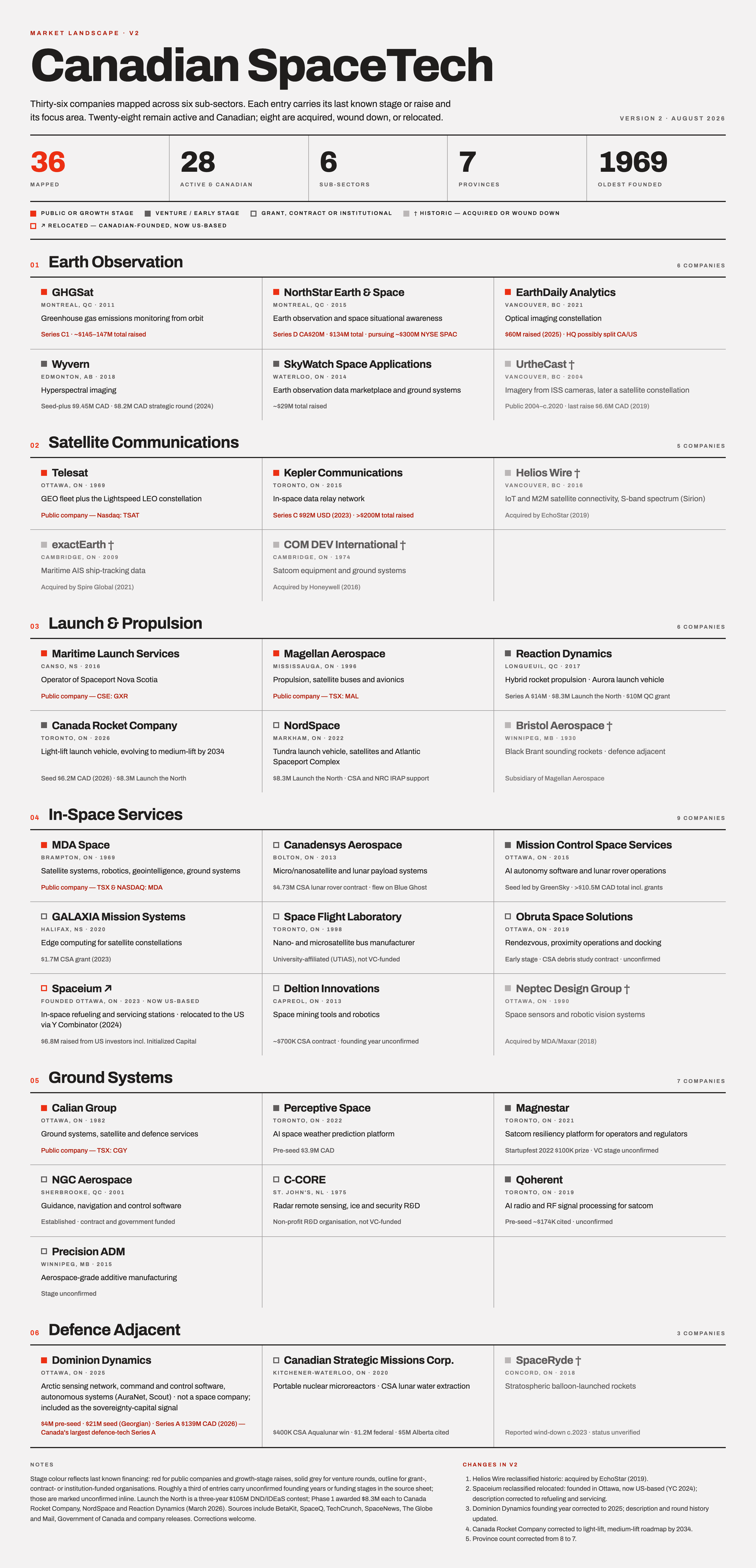
We built the map to measure how often that story repeats: 36 companies across six sub-sectors and seven provinces, the oldest founded in 1969. On the surface, it reads as a success story. Canada has been building space companies for 57 years and has produced genuine global leaders in Earth observation, satellite communications, and space robotics. Look closer at the stage data, though, and a different story emerges. It is a story about who is actually funding the Canadian space economy, and it should concern anyone who cares about where the next MDA comes from.
The anchors are old
Start with the public companies. Telesat was founded in 1969. MDA Space, also 1969. Calian, 1982. Magellan Aerospace, 1996. These are the anchors of the Canadian space economy, and every one of them predates the modern commercial space era. They were built in a world of government procurement and Cold War infrastructure, and they matured into public companies over decades.
That is a baseline, not a criticism. The question a landscape map should answer is: what is coming up behind them? Which of today's early-stage companies are on a trajectory to become the anchors of 2040?
The honest answer, based on the funding data, is that we are making it very hard to find out.
The government is Canada's angel investor
Trace the funding sources across the modern cohort and a pattern repeats. Canadensys Aerospace: a $4.73M CSA lunar rover contract. GALAXIA Mission Systems: a $1.7M CSA grant. NordSpace: CSA and NRC IRAP support. Deltion Innovations: a CSA contract. Obruta: a CSA debris study contract. Canadian Strategic Missions Corp.: a CSA Aqualunar prize, federal money, provincial money.
Then there is Launch the North, the federal launch initiative, which appears three separate times in the Launch and Propulsion column alone. Reaction Dynamics, Canada Rocket Company, and NordSpace have each drawn $8.3M from it.
Roughly a third of the companies on the map are operating primarily on grants, contracts, or institutional funding rather than private capital. In the Ground Systems column, it is the dominant mode. Across the whole landscape, the Canadian Space Agency shows up as a funding source more often than any single venture firm.
To be clear: this is the government doing its job well. Programs like CSA contracts, IRAP, and Launch the North are exactly how a country de-risks hard technology. The engineers are real, the contracts are real, and the technical milestones are real.
But grant funding and venture funding do different jobs. Grants de-risk technology. Venture capital builds companies. A grant can fund a lunar payload demonstration; it cannot fund a sales team, a second product line, or the 18 months of runway a founder needs to find commercial product-market fit. And the incentive structure points in a particular direction: when the first institutional cheque a founder receives comes from a government program instead of an investor, the rational move is to optimize for the next contract rather than the next customer. We have watched that pull operate on founders we have diligenced. It is subtle, and it compounds.
Canada has effectively made its government the country's most active pre-seed investor in space. That is a policy achievement and a market failure at the same time.
The missing middle
Now look at what sits between the grant-funded cohort and the 1969-vintage public companies. It is thin.
Count the companies on this map that have raised more than $10M in private capital: GHGSat at roughly $145M lifetime, Kepler Communications past $200M, NorthStar at $134M, EarthDaily at $60M, Reaction Dynamics with a $14M Series A, and Dominion Dynamics, a defence company rather than a space company, with its $139M round. Six companies out of 36. Below that line, the rounds get small quickly: Wyvern's seed-plus at $9.45M CAD, Perceptive Space's pre-seed at $3.9M CAD, Canada Rocket Company's seed at $6.2M CAD.
The benchmark that should sting is the United Kingdom, an economy of comparable scale with a comparable space heritage. The UK has had a dedicated SpaceTech venture fund since 2016: Seraphim, which now manages more than $550M across its private and public vehicles and closed its latest early-stage fund oversubscribed above its $100M target in early 2026, with the British Business Bank and the UK's National Security Strategic Investment Fund among its anchor investors. Note the structure of that sentence. In the UK, the government shows up as a limited partner in a private space fund. In Canada, the government shows up as the grant-writer of first resort. One model multiplies private capital; the other substitutes for it. Canada has no domestic equivalent of Seraphim, at any size, a decade after the category was proven.
The missing middle is not a talent problem. The founders exist, and the map proves it, in Halifax and Edmonton and Longueuil and Waterloo, not just in Toronto and Montreal. What is missing is the domestic capital willing to write the first private cheque and the follow-on cheques after it.
And the gap is widening at the worst possible moment. By Seraphim's global tracking, private SpaceTech investment has climbed from roughly $2 billion in 2011 to 2015 to $39 billion in the five years through 2025, the third quarter of 2025 set an all-time record, and seed is the sector's most active stage with more than 300 deals in the trailing twelve months. Seraphim expects the growth rate to exceed 100 percent from 2026 to 2030 on defence tailwinds, with more than 1 trillion euros committed to European defence and NATO members moving toward 5 percent of GDP. In global trackers, Canada does not even get its own line; it is folded, invisibly, into a North America bar the United States dominates. The world is writing first cheques into space at the fastest pace in the sector's history. Canada's absence from that wave is a choice, not a condition.
The cost of waiting
There is a warning already embedded in the data. EarthDaily Analytics, one of the stronger venture-backed stories in the Earth Observation column, now carries a note that its headquarters may be split between Canada and the United States. And Spaceium, the company this piece opened with, is the completed version of the same journey.
This is how the pattern ends if nothing changes. Canadian founders de-risk their technology on Canadian grants, hit the ceiling of available domestic capital, and raise their growth rounds from American investors who, reasonably, want the company closer to American customers and American procurement. The IP, the jobs, and the eventual exit migrate south. Canada keeps the alumni network and the case study.
We have run this experiment before in other sectors. There is no reason to expect a different result in space, except that in space and defence the stakes now include sovereignty, not just economics.
What the map is telling us
Read as a whole, the landscape says three things.
First, the Canadian space sector is real, national in scope, and technically credible. Thirty-six companies across seven provinces is not a niche.
Second, the government has done its part. The grant and contract layer is functioning. The pipeline of de-risked, contract-validated companies exists.
Third, the private capital layer that should sit on top of that pipeline mostly does not exist yet. The gap between grant-funded and growth-stage is where the next generation of Canadian space anchors will either be built or lost.
To be sure, one nine-figure exception proves the capital exists. Dominion Dynamics, an Ottawa company building Arctic-hardened sensors, command software, and drones, raised a $139M CAD Series A in 2026, the largest in Canadian defence-tech history, within roughly a year of founding, after a $4M pre-seed backed almost entirely by Canadian investors. It is not a space company, and that is the point: Canadian conviction capital moves fast when the sovereignty case is clear. It has not yet reached the space columns of this map, at the point where it matters most: the first cheque.
Where we stand
We should be direct about our position, because this map is not neutral analysis, and because we have been on the record about this gap for five years.
In September 2021, Carvalho Capital, our family office, publicly declared that it would be the first cheque in for SpaceTech founders. At the time, the numbers we cited were a global space market projected past $1 trillion by 2040, a Canadian share of roughly 1.3 percent, and a domestic sector contributing $2.5 billion and 21,000 jobs. We argued then that Canada's space economy would not reach its potential without early-stage private capital, and we backed the argument the only way that counts: Carvalho Capital has since written first cheques into five space technology companies.
Five years later, we built this map to test whether the gap we bet on was real. It is. The 2021 argument now has 36 data points, and it has hardened into HUMANUS.VC, which invests at pre-seed and seed in commercial space and allied defence technology across Canada and its Five Eyes partners. We did not arrive at the first-cheque gap by reading about it. We arrived at it by writing cheques into it, and then by counting who else showed up. The count is on the map.
So read this landscape the way we do: not as a directory, but as a pipeline. The grant layer is working. The founders are real. What Canada builds next depends on who shows up at the stage before the story gets easy.
This is Version 2 of the map; Version 1 was corrected within a week of being built, which is exactly how a living document should behave. The map, and the argument, will be updated as the landscape changes.
A note on the data: this analysis draws on Version 2 of our Canadian SpaceTech landscape map (August 2026). Roughly a third of entries carry unconfirmed founding years or funding stages in the source data, and figures cited here reflect last known public information from sources including BetaKit, SpaceQ, TechCrunch, SpaceNews and company releases. Global investment figures are drawn from Seraphim Space's published market tracking. Corrections are welcome.